Provision Charitable Foundation


Water Project
Phase 1 Complete!
Our project has succesfully provided a year-round supply of clean, accessible water in large enough supply to be used for multiple family purposes and the irrigation of crops.
 |  |
|---|---|
 |  |
 |  |
 |  |
 |  |
Clean
Clean water, purified at source for drinking purposes, not only directly reduces disease but makes many areas of life much simpler and can have long term related but unexpected results. Clean drinking water means that water does not have to be boiled before use. Therefore the mother and children do not have to spend large amounts of time and energy gathering firewood to burn to boil water. This leaves time for other productive activities, such as farming and reduces deforestation and pollution from burning.Clean water, accessible and available in large enough quantities to be used freely for washing and personal hygiene is essential for health in the long term.
Accessible
Accessible water means that hours spent walking and returning from obtaining water can be spent on productive activity. The combination of regularly retrieving water and then obtaining wood to boil can take many hours and in many cases is just not able to be done. Again the result is a better allocation of resources, moving people beyond basic survival to a long term improvement in living conditions.
Supply
Thanks to the generous support of donors, we have been able to drill a Well which has produced very good water flow. This reliable, year round supply of water not only simplifies daily living but allows multiple crops during the year, crops that are larger and provide a more year round source of food. There is land and labour, along with sun in Africa. Water is always the limiting factor.
Now that we have met the objective of providing a source of supply with adequate consistent flow, we can move forward in exploring and educating the community in different irrigation and farming techniques.
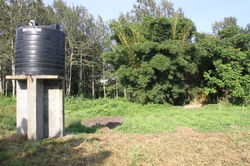
There is already a distribution system that delivers water to the village of Panera through three taps strategically placed in the village. There is also a distribution system that delivers water to he Kasita High School. This water comes from the two storage tanks. The Kasita high school also has the distribution system in place with adequate shower and sanitary facilities.
The villagers are basically intact families, father and mother and children, who are struggling to make a living for their families and are very receptive to learning these new skills. The struggle is a standard struggle, wood and water and then food.
New irrigation techniques are being introduced at the vegetable gardens of Kastia and all parties, including villagersare being trained on using the water available efficiently for irrigation purposes. Once they have been trained and seen the fruits of the efficient equipment, new equipment will be supplied to the village, likely a portable irrigation system owned communally and used by the villagers on a rotating basis.
There is also the potential to introduce bothsolar lighting and solar cooking to enhance the quality of life of the villagers and reduce deforestation and air pollution through burning.